Kondo and beyond – recent insight from scanning probe measurements
by
Physics/019
NTHU
The electron spin, a fundamental quantum mechanical property, plays a crucial role in determining the electronic and magnetic properties as well as the dynamics of matter. In magnetic materials, magnons represent the elementary excitations of a macroscopically ordered ground-state spin configuration. These excitations allow the transfer of spin angular momentum without involving charge transport. Spin excitations, in general, are essential for understanding magnetic-bit manipulations, defining the associated lifetimes, relaxation times, read and write times, and dissipation. Therefore, a fundamental understanding of spin excitations is significant for both fundamental science and modern applications.
Recent first-principles calculations predicted the existence of many-body states [1], called spinarons, a magnetic polaron that arises from the interaction of spin excitations with conduction electrons in the presence of spin-orbit coupling. These results challenge the decades-old Kondo effect paradigm, which was previously believed to emerge in Co atoms on the (111) surface of noble metals.
I will present experimental evidence for the existence of spinaronic states in Co atoms on the Cu(111) surface. Our spin-averaged and spin-polarized scanning tunnelling spectroscopy measurements in high magnetic fields allow us to discriminate between the different existing theoretical models and to invalidate the prevailing Kondo-based interpretation of the zero-bias anomaly. Ab initio calculations instead suggest the presence of multiple spinaronic states.
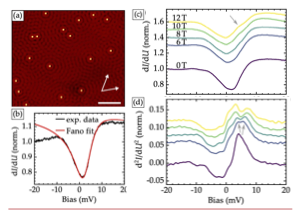
Figure: (a) Topographic scan of the Cu(111) surface with adsorbed Co atoms. The standing wave pattern formed by Friedel oscillations of the Cu(111) surface state is visible. Scale bar is 10 nm. (b) dI/dU spectrum recorded atop a single Co atom (black curve) fitted with a Fano curve (red line). The fit was performed in the range of (−10, +10) mV. (c) dI/dU spectra taken atop a single Co atom in an out-of-plane external magnetic field of up to 12 T. The gray arrow indicates the appearance of a kink in the rising edge of the ZBA at high magnetic fields (T= 1.4 K). (d) Numerically
[1] Bouaziz et al., Nat. Commun. 11, 6112 (2020)